In linearer Algebra ist die Spur eines ist definiert als die Summe der Elemente auf der Hauptdiagonale (die Diagonale von oben links nach unten rechts) von .


Die Spur einer Matrix ist die Summe der (komplexen) Eigenwerte und ist bezüglich einer Basisänderung invariant. Diese Charakterisierung kann verwendet werden, um allgemein die Spur eines linearen Operators zu definieren. Beachten Sie, dass die Kurve nur für eine quadratische Matrix definiert ist (dh . ).
Die Spur (oft als tr abgekürzt) steht im Zusammenhang mit der Ableitung der Determinante (siehe Jacobis Formel).
Definition [ edit ]
Die -Spur eines quadratische Matrix A ist definiert als [1]: [1] p. 34

wobei bezeichnet der Eintrag in der i ten Zeile und i th Spalte von .

Beispiel [ edit ]
Es sei eine Matrix, mit
- { displaystyle A = { begin {pmatrix} a_ {11} & a_ {12} & a_ {13} \ a_ {21} & a_ {22} & a_ {23} \ a_ {31} & a_ {32} & a_ {33} end {pmatrix}} = { begin {pmatrix} -1 & 0 & 3 \ 11 & 5 & 2 \ 6 & 12 & -5 end {pmatrix}}.}
 { displaystyle A = { begin {pmatrix} a_ {11} & a_ {12} & a_ {13} \ a_ {21} & a_ {22} & a_ {23} \ a_ {31} & a_ {32} & a_ {33} end {pmatrix}} = { begin {pmatrix} -1 & 0 & 3 \ 11 & 5 & 2 \ 6 & 12 & -5 end {pmatrix}}.}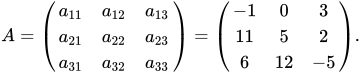
Dann

Eigenschaften [ bearbeiten ]
Basismerkmale edit ]
Die Spur ist eine lineare Abbildung. Das ist,
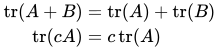
für alle quadratischen Matrizen und und alle Skalare [1]: [1] p. 34

Eine Matrix und ihre Transpose haben die gleiche Spur: [1]: p. 34

Dies ergibt sich unmittelbar aus der Tatsache, dass die Transponierung einer quadratischen Matrix keine Elemente entlang der Struktur beeinflusst Hauptdiagonale.
Produktspur [ edit ]
Die Produktspur zweier Matrizen kann als Summe der Eintrittsprodukte von Elementen umgeschrieben werden:

T Dies bedeutet, dass die Spur eines Produkts von Matrizen ähnlich funktioniert wie ein Punktprodukt von Vektoren . Aus diesem Grund beinhalten Verallgemeinerungen von Vektoroperationen auf Matrizen (z. B. in Matrixberechnung und Statistik) oft eine Spur von Matrixprodukten.
Für echte Matrizen und

-
-
- (unter Verwendung des Hadamard-Produkts, dh des Eintrittsproduktes).
-

-
-
- (unter Verwendung des Vektorisierungsoperators)
-
in
Die Matrizen in einer Produktspur können gewechselt werden, ohne das Ergebnis zu ändern: Wenn m ist Matrix und ist eine [1]: [1]: p. 34 [note 1]

 [1]: [1]:
Zyklisches Eigentum [ edit ]
Im Allgemeinen ist die Spur invariant unter cyclischen Permutationen ]dh

Dies wird als zyklische Eigenschaft bezeichnet.
Beachten Sie, dass beliebige Permutationen nicht zulässig sind: Im Allgemeinen

Wenn jedoch Produkte von drei symmetrischen -Matrizen in Betracht gezogen werden, ist jede Permutation zulässig. (Beweis: wobei der erste Gleichheit ist, weil die Spuren einer Matrix und ihrer Transponierten gleich sind.) Bei mehr als drei Faktoren trifft dies im Allgemeinen nicht zu.

Spur eines Matrixprodukts [ edit ]
Im Gegensatz zur Determinante ist die Spur des Produkts nicht das Produkt von Spuren, d. H. Es existieren Matrizen und B "/> B

Spur eines Kronecker-Produkts [ edit ]
Was wahr ist, ist, dass die Spur des Kronecker-Produkts zweier Matrizen das Produkt ihrer Spuren ist:
- . 19659545] Vollständige Charakterisierung der Spur [ edit ]
Die folgenden drei Eigenschaften:
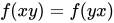
charakterisieren die Spur vollständig im folgenden Sinn. sei eine lineare Funktion auf dem Raum quadratischer Matrizen, die
f x [19659051] y ) = f ( y x ) {193] f (xy) = f (yx)] . Dann und sind proportional. [note 2]Ähnlichkeitsinvarianz [ edit ]
Die Spur ist gleichheitsinvariant, was bedeutet, dass für jede quadratische Matrix A A [19456525] gilt ] { displaystyle A} und jede invertierbare Matrix der gleichen Abmessungen, die Matrizen und hat die gleiche Spur. Das ist weil
- 1 ( A P ) ; ( ( A P ) P - 1 ] 19659003] 19 ( A ( P P - 1 ) (19659106) ( A ) . { displaystyle operatorname {tr} left (P ^ {- 1} AP right) = operatorname {tr} left (P ^ {- 1} (AP) right) = operatorname {tr} left ((AP) P ^ {- 1} right) = operatorname {tr} left (A left (PP ^ {- 1} right) right) = operatorname {tr} (A).}
Produktspur einer symmetrischen und schrägsymmetrischen Matrix [ edit ]
If ist symmetrisch und ist dann schrägsymmetrisch
- .
Beziehung zu Eigenwerten [ edit ]
Spur der Identitätsmatrix [ edit ]
Die Spur der [19456540] [19456540] [19456540] ist [19456540] die Dimension des Raums, dh .
Dies führt zu Verallgemeinerungen der Dimension mit Hilfe von trace.
Spur einer idempotenten Matrix [ edit ]
Die Spur einer idempotenten Matrix (dh eine Matrix, für die ) ist der Rang von .
Spur einer Nilpotent-Matrix [ edit ]
Die Spur einer Nilpotent-Matrix ist Null.
Spur entspricht der Summe der Eigenwerte [ edit ]
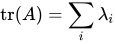
Allgemeiner, wenn einer Matrix
d.h. Die Spur einer quadratischen Matrix entspricht der Summe der mit Multiplizitäten gezählten Eigenwerte.
Spur des Kommutators [ edit ]
Wenn beide und sind Kommutators von und verschwindet: . Man kann dies als "die Spur ist eine Karte von Lie Algebren von Operatoren zu Skalaren ", da der Kommutator von Skalaren trivial ist (es ist eine abelsche Lie-Algebra). Unter Verwendung der Ähnlichkeitsinvarianz folgt insbesondere, dass die Identitätsmatrix niemals dem Kommutator eines Paars von Matrizen ähnelt.
Umgekehrt ist jede quadratische Matrix mit einer Nullspur eine Linearkombination der Kommutatoren von Paaren von Matrizen. [note 3] Außerdem ist jede quadratische Matrix mit einer Nullspur einheitlich einer quadratischen Matrix mit einer aus Nullen bestehenden Diagonalen äquivalent.
Spur der Kräfte von nilpotenten Matrizen [ edit ]
Die Spur einer beliebigen Kraft einer nilpotentischen Matrix ist Null. Wenn die Charakteristik des Basisfelds Null ist, gilt auch die Umkehrung: Wenn für alle dann ist nilpotent.
Spur der Hermitianischen Matrix [ edit ]
Die Spur einer Hermitianischen Matrix ist real, weil die Elemente auf der Diagonale real sind.
Spur der Projektionsmatrix [ edit ]
Die Spur einer Projektionsmatrix ist die Dimension des Zielraums.
- Rang
Rang Rang Rang rank 19 ] ( X ) . { displaystyle { begin {align} P_ {X} & = X left (X ^ { textsf {T}} X right) ^ {-1} X ^ { textsf {T}} \ [3pt] Longrightarrow operatorname {tr} left (P_ {X} right) & = operatorname {rank} (X). End {ausgerichtet }}}
Beachten Sie das ist idempotent und im Allgemeinen entspricht die Spur einer idempotenten Matrix ihrem Rang.
Exponentialspur [ edit ]
Ausdrücke wie wobei eine quadratische Matrix ist, die in manchen Bereichen so häufig vorkommt (z. B. multivariate statistische Theorie), dass eine Kurzschriftnotierung üblich geworden ist:
Dies wird manchmal als exponentiale - Funktion bezeichnet. es wird in der Golden-Thompson-Ungleichung verwendet.
Spur eines linearen Operators [ edit ]
Gegeben einer linearen Karte (wobei ist ein endlicher (19459180] dimensionaler Vektorraum). Im Allgemeinen können wir die Spur dieser Karte definieren, indem wir die Spur der Matrixdarstellung von f betrachten, dh eine Basis für auswählen. V und beschreibt f als Matrix bezüglich dieser Basis und nimmt die Spur dieser quadratischen Matrix. Das Ergebnis hängt nicht von der gewählten Basis ab, da unterschiedliche Basen zu ähnlichen Matrizen führen, wodurch die Möglichkeit einer basenunabhängigen Definition der Spur einer linearen Karte ermöglicht wird.
Eine solche Definition kann unter Verwendung des kanonischen Isomorphismus zwischen dem Raumende ( V ) linearer Karten auf und angegeben werden ist der -Doppelraum von . sei und ließ [19659600] f
{ displaystyle f} f . Dann die Spur des unverbaubaren Elements ist definiert als ; Die Spur eines allgemeinen Elements wird durch die Linearität definiert. Verwendung einer expliziten Basis für und der entsprechenden dualen Basis für kann man zeigen, dass dies die gleiche Definition der Spur wie oben gibt.Eigenwertbeziehungen [ edit ]
If ist ein linearer Operator, der durch ein Quadrat dargestellt wird Matrix mit realen oder komplexen Einträgen und if sind die Eigenwerte von (aufgeführt nach ihren algebraischen Multiplizitäten ), dann
Dies folgt aus der Tatsache, dass immer seiner Jordanform ähnelt eine obere dreieckige Matrix mit auf der Hauptdiagonale. Im Gegensatz dazu ist die Determinante von das -Produkt seiner Eigenwerte; d.h.
Allgemeiner
- .
Ableitungen [ edit ]
Die Spur entspricht der Ableitung der Determinante: Sie ist das Lie-Algebra-Analogon der (Lie-Gruppe) -Karte der Determinante. Dies wird in Jacobis Formel für die Ableitung der Determinante präzisiert.
Als besonderer Fall an der Identität stellt die Ableitung der Determinante tatsächlich die Spur dar: . Daraus (oder aus der Verbindung zwischen der Spur und den Eigenwerten) kann eine Verbindung zwischen der Trace-Funktion, der Exponentialkarte zwischen einer Lie-Algebra und ihrer Lie-Gruppe (oder konkret der Exponentialfunktion der Matrix ) und abgeleitet werden die Determinante:
- .
Betrachten Sie beispielsweise die durch Rotation durch den Winkel gegebene Familie der linearen Transformationen mit einem Parameter ,
These transformations all have determinant 1 , so they preserve area. The derivative of this family at θ = 0, the identity rotation, is the antisymmetric matrix
which clearly has trace zero, indicating that this matrix represents an infinitesimal transformation which preserves area.
A related characterization of the trace applies to linear vector fields. Given a matrix define a vector field on by . The components of this vector field are linear functions (given by the rows of ). Its divergence is a constant function, whose value is equal to .
By the divergence theorem, one can interpret this in terms of flows: if represents the velocity of a fluid at location and is a region in the net flow of the fluid out of is given by where is the volume of .
The trace is a linear operator, hence it commutes with the derivative:
Applications[edit]
The trace of a 2-by-2 complex matrix is used to classify Möbius transformations. First the matrix is normalized to make its determinant equal to one. Then, if the square of the trace is 4, the corresponding transformation is parabolic. If the square is in the interval [04)itiselliptic. Finally, if the square is greater than 4, the transformation is loxodromic. See classification of Möbius transformations.
The trace is used to define characters of group representations. Two representations of a group G are equivalent (up to change of basis on V) if for all g ∈ G.
The trace also plays a central role in the distribution of quadratic forms.
Lie algebra[edit]
The trace is a map of Lie algebras from the Lie algebra gln of operators on a n-dimensional space matrices) to the Lie algebra k of scalars; as k is abelian (the Lie bracket vanishes), the fact that this is a map of Lie algebras is exactly the statement that the trace of a bracket vanishes:
The kernel of this map, a matrix whose trace is zero, is often said to be traceless or tracefreeand these matrices form the simple Lie algebra slnwhich is the Lie algebra of the special linear group of matrices with determinant 1. The special linear group consists of the matrices which do not change volume, while the special linear Lie algebra is the matrices which infinitesimally do not change volume.
In fact, there is an internal direct sum decomposition of operators/matrices into traceless operators/matrices and scalars operators/matrices. The projection map onto scalar operators can be expressed in terms of the trace, concretely as:
Formally, one can compose the trace (the counit map) with the unit map of "inclusion of scalars" to obtain a map mapping onto scalars, and multiplying by n. Dividing by n makes this a projection, yielding the formula above.
In terms of short exact sequences, one has
which is analogous to
for Lie groups. However, the trace splits naturally (via times scalars) so but the splitting of the determinant would be as the nth root times scalars, and this does not in general define a function, so the determinant does not split and the general linear group does not decompose:
Bilinear forms[edit]
The bilinear form
is called the Killing form, which is used for the classification of Lie algebras.
The trace defines a bilinear form:
( square matrices).
m
The form is symmetric, non-degenerate[note 4] and associative in the sense that:For a complex simple Lie algebra (e.g., ), every such bilinear form is proportional to each other; in particular, to the Killing form.
Two matrices and are said to be trace orthogonal if
- .
Inner product[edit]
For an matrix with complex (or real) entries and being the conjugate transpose, we have
with equality if and only if .[2]:p. 7
The assignment
yields an inner product on the space of all complex (or real) matrices.
The norm derived from the above inner product is called the Frobenius norm, which satisfies submultiplicative property as matrix norm. Indeed, it is simply the Euclidean norm if the matrix is considered as a vector of length .
It follows that if and are real positive semi-definite matrices of the same size then
Generalizations[edit]
The concept of trace of a matrix is generalized to the trace class of compact operators on Hilbert spaces, and the analog of the Frobenius norm is called the Hilbert–Schmidt norm.
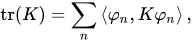
If is trace-class, then for any orthonormal basis the trace is given by
and is finite and independent of the orthonormal basis.[3]
The partial trace is another generalization of the trace that is operator-valued. The trace of a linear operator which lives on a product space is equal to the partial traces over and : For more properties and a generalization of the partial trace, see the article on traced monoidal categories.
A supertrace is the generalization of a trace to the setting of superalgebras.
The operation of tensor contraction generalizes the trace to arbitrary tensors.
Coordinate-free definition[edit]
We can identify the space of linear operators on a vector space defined over the field with the space where . We also have a canonical bilinear function that consists of applying an element of to an element of to get an element of in symbols . This induces a linear function on the tensor product (by its universal property) which, as it turns out, when that tensor product is viewed as the space of operators, is equal to the trace.
This also clarifies why and why as composition of operators (multiplication of matrices) and trace can be interpreted as the same pairing. Viewing one may interpret the composition map as
coming from the pairing on the middle terms. Taking the trace of the product then comes from pairing on the outer terms, while taking the product in the opposite order and then taking the trace just switches which pairing is applied first. On the other hand, taking the trace of A and the trace of B corresponds to applying the pairing on the left terms and on the right terms (rather than on inner and outer), and is thus different.
In coordinates, this corresponds to indexes: multiplication is given by so and which is the same, while which is different.
For finite-dimensional, with basis and dual basis then is the ij-entry of the matrix of the operator with respect to that basis. Any operator is therefore a sum of the form . With defined as above, . The latter, however, is just the Kronecker delta, being 1 if and 0 otherwise. This shows that is simply the sum of the coefficients along the diagonal. This method, however, makes coordinate invariance an immediate consequence of the definition.
Dual[edit]
Further, one may dualize this map, obtaining a map . This map is precisely the inclusion of scalars, sending 1 ∈ F to the identity matrix: "trace is dual to scalars". In the language of bialgebras, scalars are the unitwhile trace is the counit.
One can then compose these, which yields multiplication by nas the trace of the identity is the dimension of the vector space.
See also[edit]
References[edit]
- ^ a b c d Lipschutz, Seymour; Lipson, Marc. Schaum's Outline of Theory and Problems of Linear Algebra. McGraw-Hill. ISBN 9780070605022.
- ^ Horn, Roger A.; Johnson, Charles R. (2013). Matrix Analysis, second edition. Cambridge University Press. ISBN 9780521839402.
- ^ Teschl, G. (30 October 2014). Mathematical Methods in Quantum Mechanics. Abschluss in Mathematik. 157 (2nd ed.). Amerikanische Mathematische Gesellschaft. ISBN 1470417049.
- ^ This is immediate from the definition of the matrix product:
- .
- ^ Proof:
- if and only if and (with the standard basis ), and thus
More abstractly, this corresponds to the decomposition as tr(AB) = tr(BA) (equivalently, ) defines the trace on slnwhich has complement the scalar matrices, and leaves one degree of freedom: any such map is determined by its value on scalars, which is one scalar parameter and hence all are multiple of the trace, a non-zero such map. - ^ Proof: is a semisimple Lie algebra and thus every element in it is a linear combination of commutators of some pairs of elements, otherwise the derived algebra would be a proper ideal.
- ^ This follows from the fact that if and only if
- ^ Can be proven with the Cauchy–Schwarz inequality.
External links[edit]


 . Dann


![{ displaystyle f (x) = (x- lambda _ {1}) ^ {d_ {1}} cdot ldots cdot (x- lambda _ {k}) ^ {d_ {k}}} [19659011] ist das charakteristische Polynom <a href=](https://wikimedia.org/api/rest_v1/media/math/render/svg/1c56a3bc9212052e3e180482260aead04531c42a) einer Matrix
einer Matrix 
![{ displaystyle operatorname {tr} ([A,B]) = 0}](https://wikimedia.org/api/rest_v1/media/math/render/svg/aa090c8b1652e285edea85faddd3d357cf34b9d6)


![{ displaystyle { begin {align} P_ {X} & = X left (X ^ { textsf {T}} X right) ^ {- 1} X ^ { textsf {T }} \ [3pt] Longrightarrow operatorname {tr} left (P_ {X} right) & = operatorname {rank} (X). End {56}}}](https://wikimedia.org/api/rest_v1/media/math/render/svg/d87139d0e256414cf9527253bf66378a6076788c)













![{displaystyle operatorname {tr} ([A,B])=0.}](https://wikimedia.org/api/rest_v1/media/math/render/svg/7f735de90720e844ba0205d79458612e62524223)






![B(x,y)=operatorname {tr} (operatorname {ad} (x)operatorname {ad} (y)){text{ where }}operatorname {ad} (x)y=[x,y]=xy-yx](https://wikimedia.org/api/rest_v1/media/math/render/svg/d22d95361ba79104ccce1b9e1f17f0ca601f057b)


![{displaystyle operatorname {tr} (x[y,z])=operatorname {tr} ([x,y]z).}](https://wikimedia.org/api/rest_v1/media/math/render/svg/c08535f446274ef8943c101399e16337eef618cc)


![{displaystyle 0leq left[operatorname {tr} (AB)right]^{2}leq operatorname {tr} left(A^{2}right)operatorname {tr} left(B^{2}right)leq left[operatorname {tr} (A)right]^{2}left[operatorname {tr} (B)right]^{2}.}](https://wikimedia.org/api/rest_v1/media/math/render/svg/ff89e9da78a13995a20ee7e86348255ee487ac79)




![{displaystyle operatorname {tr} ([a,b])}](https://wikimedia.org/api/rest_v1/media/math/render/svg/113c1a8cb94ba8c0b040ca5e89d69ed772a94ee1)








![{displaystyle f(A)=sum _{i,j}[A]_{ij}fleft(e_{ij}right)=sum _{i}[A]_{ii}fleft(e_{11}right)=fleft(e_{11}right)operatorname {tr} (A).}](https://wikimedia.org/api/rest_v1/media/math/render/svg/e7b6565dcac9d53a5cc0c3fba88b1c4461987735)
![{textstyle operatorname {tr} ([A,B])=0}](https://wikimedia.org/api/rest_v1/media/math/render/svg/cb865ceb5947d408cc4499b0e3abb3fae55ff9ff)


No comments:
Post a Comment